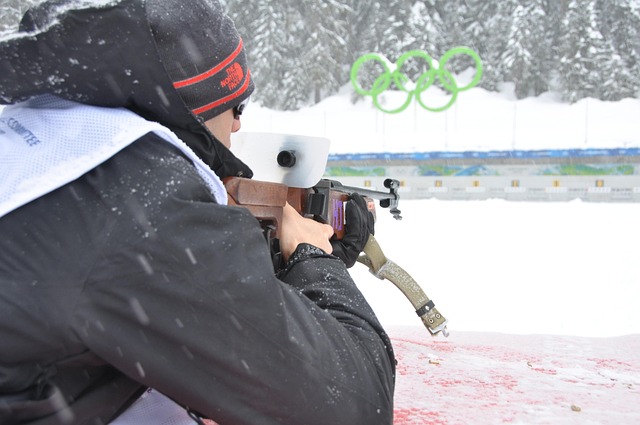
Biathlon is one of the most unique and demanding sports at the Winter Olympic Games because it combines two completely different skills: cross-country skiing and rifle shooting. Athletes race over snow-covered courses while stopping at shooting ranges to hit a series of targets. Success in biathlon requires endurance, speed, precision, and the ability to control breathing and heart rate under extreme physical stress.
Unlike many winter sports that focus only on speed or technique, biathlon forces athletes to switch between intense aerobic effort and calm, steady accuracy. A missed shot can cost valuable time, which means that physical strength alone is not enough to win at the Olympic level.
Origins and Olympic History of Biathlon
Biathlon has its roots in winter survival skills practiced in Scandinavia, where people used skis and rifles for travel and hunting in snowy terrain. Military patrol competitions in the early 20th century helped shape the sport, combining long-distance skiing with shooting.
Biathlon was first included in the Winter Olympics in 1960. Since then, it has evolved into one of the most popular winter endurance sports. Over time, more events were added, including women’s competitions and mixed relay formats, expanding the sport’s global reach and Olympic presence.
How Biathlon Competitions Work
In Olympic biathlon, athletes ski multiple laps around a course and stop at a shooting range several times during the race. At each shooting stage, they must hit five targets with a small-caliber rifle. Targets are positioned 50 meters away, and the shooting format alternates between prone (lying down) and standing positions.
The difficulty of the shooting depends on the position. Prone targets are larger and slightly easier to hit, while standing targets are smaller and require greater control. Athletes carry their rifles on their backs throughout the race, adding weight and affecting balance.
If a biathlete misses a target, there is a penalty. In some events, each miss results in a penalty loop, where the athlete must ski an extra short lap before continuing. In others, a time penalty is added to the final result. Because races are often decided by seconds, accurate shooting is just as important as fast skiing.
Major Biathlon Events at the Olympics
Biathlon includes several Olympic event formats, each testing different aspects of endurance and strategy.
The individual race is the longest event and features multiple shooting stages. Missed shots usually result in time penalties rather than extra skiing, making accuracy especially important.
The sprint is shorter and faster. Athletes complete fewer laps and shooting stages, and each miss typically requires a penalty loop. Sprint results often determine starting positions for the pursuit race.
In the pursuit, athletes start based on their sprint results, with time gaps carried over. This head-to-head format adds tactical racing and direct competition between athletes.
The mass start features all top competitors starting together. With limited space at the shooting range and close racing on the course, the mass start is intense and dramatic.
Relay events involve teams of athletes, each completing a portion of the race. Mixed relays combine male and female athletes on the same team, highlighting teamwork and strategy.
Equipment and Technology in Biathlon
Biathlon rifles are small-caliber and highly specialized for the sport. They are designed to be lightweight and easy to handle, with custom adjustments for each athlete. Competitors must quickly switch from skiing to shooting, often lowering their heart rate in seconds before firing.
Skis and poles are similar to those used in cross-country skiing, with equipment tailored for speed and efficiency. Wax selection is crucial, as snow temperature and texture can significantly affect glide. Even small equipment adjustments can influence performance over long distances.
Physical and Mental Demands
Biathlon athletes need exceptional cardiovascular endurance, as races involve sustained high-intensity skiing. At the same time, they must have the strength and stability to shoot accurately after hard effort.
Mental control is one of the most important aspects of biathlon. Athletes must calm their breathing and steady their aim immediately after skiing at high speed. The ability to block out noise, pressure, and fatigue is essential, especially in close Olympic races.
Decision-making also plays a role. Skiers must pace themselves carefully, knowing that arriving at the shooting range too exhausted can lead to missed shots and costly penalties.
Biathlon Venues and Course Design
Olympic biathlon venues feature rolling terrain with a mix of climbs, descents, and flat sections. Courses are designed to challenge endurance and technique while allowing for spectator viewing near the shooting range.
The shooting range is a central part of the venue, often located in a stadium area where fans can watch athletes arrive, shoot, and leave for the next lap. Weather conditions such as wind and snowfall can affect shooting accuracy and ski speed, adding another layer of challenge.
Why Biathlon Matters at the Winter Olympics
Biathlon stands out at the Winter Olympics because it combines physical power with precision skill in a single event. The constant shifts between racing and shooting create suspense, as a leading athlete can lose their advantage with one missed shot.
The sport also highlights the mental side of competition, showing how focus and control can be as important as strength and speed. Biathlon’s mix of endurance, accuracy, and strategy makes it one of the most complete and dramatic events on the Winter Olympic program.
As a result, biathlon remains a core winter sport and a favorite among Olympic fans, representing both the tradition of winter survival skills and the modern pursuit of athletic excellence.