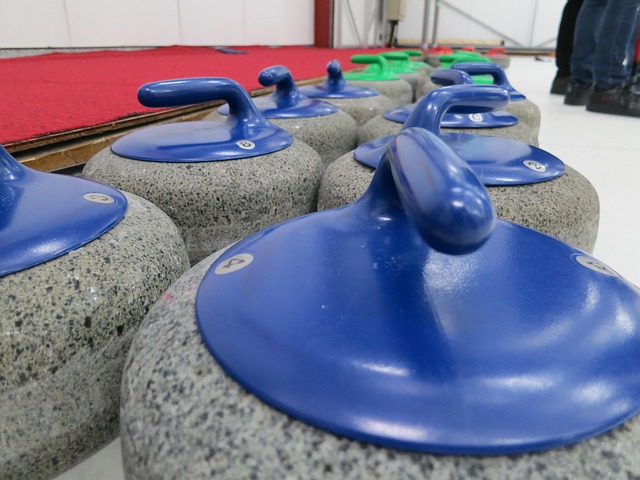
Curling scoring at the Olympic Winter Games is simple in concept but highly strategic in practice. Unlike many sports where points come from individual actions, curling awards points at the end of each segment of play based on stone placement. Understanding how scoring works helps explain why teams value precision, patience, and long-term strategy over raw power.
Points Are Awarded by End
A curling match is divided into ends, which function similarly to innings in baseball. During each end, both teams take turns sliding a set number of stones toward the house, the circular target area at the far end of the sheet of ice. After all stones in that end have been delivered, the scoring is determined.
Only one team can score in a given end. The team with the stone closest to the center of the house, known as the button, earns points.
Counting the Stones
To calculate the score in an end, officials look at which team has the closest stone to the button. That team receives one point for every one of its stones that is closer to the center than the opponent’s nearest stone.
For example, if Team A has the closest stone, and also the second-closest and third-closest stones before any stone from Team B, Team A scores three points in that end. As soon as a stone from the other team is closer than the next one, counting stops.
Only stones that are inside the house count for scoring. Stones outside the rings do not earn points, no matter how close they are to the center line.
The Importance of the Hammer
The last stone thrown in each end is called the hammer, and it often provides a scoring advantage. Having the hammer allows a team to make the final shot of the end, which can be used to score or to remove an opponent’s scoring stone.
Teams with the hammer often try to score two or more points in an end. If the team with the hammer scores, the hammer switches to the other team for the next end. If an end finishes with no score, known as a blank end, the same team keeps the hammer for the following end.
Measuring Close Shots
In tight situations, it can be difficult to see which stone is closer to the button. When this happens, officials use measuring devices to determine exact distances. These measurements can decide not only who scores, but how many points are awarded.
Because a single stone’s position can change the score of an entire end, teams focus heavily on precise weight, angle, and sweeping to control exactly where each stone finishes.
Strategy Behind the Scoring System
The curling scoring system encourages long-term thinking. A team might choose to score only one point in an end in order to gain the hammer in the next one. Late in a game, teams that are behind may take more risks to try to score multiple points in a single end.
This structure makes curling a sport of momentum and planning. Every end builds on the previous one, and scoring is not just about being closest to the center, but about managing the hammer, controlling the house, and setting up future opportunities.